
The Conflict Resolution Paradigm
Divine Collaboration, a powerful conflict resolution paradigm, is perhaps the most effective mediation process available. It is a reconciliation approach that can be applied in a multitude of settings, with a wide range of disputants.
In this unique approach, mediation participants evaluate their intentions—their interests, needs, and desires—against a baseline of Divine Will. When they compare their free will intentions with the Will of God, they increase the probability they will achieve the greatest possible mutual benefit.
Divine Collaboration success depends on generating trust in the concept of positive reciprocity: if I help the other person satisfy their needs, they will help me satisfy my needs.
Initially, skilled mediators nurture trust in the process, which is based on reciprocity. Participants agree to “see how it works.”
Initially, mediators and pastoral counselors provide the good will. They create trust and affinity with each individual disputant. When a disputant sees his opposition adopt a collaborative spirit and enjoy trust with the mediator, he tends to copy the demeanor.
Good will then slowly transfers from the mediator disputant relationship, to the relationship between disputants. This takes place even with hostile disputants who intend to prevail “at any cost.” Though the dispute may have seemed intractable, mediators find peace and reconciliation possible. This is good news for a world beset with conflict.
Paradigm Shift
However, just as I began to feel optimistic—certain that we have tools to make world peace possible—I encountered anomalies, a small percentage of conflicts that do not appear to respond to reconciliation efforts. These intractable disputes demand a second look: do they warrant a shift in our peacemaking paradigm?
At first glance, we might assume that such a small percentage of cases that resist resolution will not impede overall progress toward peace in the world. We would be wrong. Their impact is huge. If these types of conflict remain unresolved, they sabotage all other peacemaking efforts.
In other words, despite our development of an effective conflict resolution protocol, Divine Collaboration, a small set of conflicts remain a threat to our goal of world peace. How do we recognize this unique set of disputes? How do we know we have encountered this anomalous set of disputes?
There is one key factor: these conflicts are grounded in direct opposition to the Will of God. The hostile party’s underlying impulse or intention is to oppose God. Some call this evil. Some speak of Satan. Gnostics posit a Demiurge, a false god that traps souls. Nihilists fall in this category.
As these disputes center on opposition to the Will of God, it is clear there can be no alignment with the Will of God. Collaboration becomes impossible. These conflicts are rooted in existential or ontological opposition to Creation. They appear to be part of the original code of this universe.
For example, where the Will of God calls on us to love one another, direct opposition calls for destruction or enslavement. Where the Will of God calls on us to contribute to creation, direct opposition calls for destruction. Calls for compassion are opposed by calls for cruelty. Expectations of immortality, expectations of continuity of consciousness, are opposed by a narrative that says consciousness vanishes into eternal darkness.
Direct opposition manifests in genocidal bioweapons—as in the COVID pandemic. It manifests as savage, brutal wars—like the war in Ukraine where over a million humans have perished. Evil manifests as threats of nuclear war, designed to wipe out all life on the planet.
Opposition to the Will of God manifests as Communism coupled with digital enslavement. Opposition manifests in hateful ideologies that drive localized genocide and in terrorism that seeks to force mankind to “submit.” It can be seen in the anarchy of criminal cartels that destroy civilization, neighborhood by neighborhood.
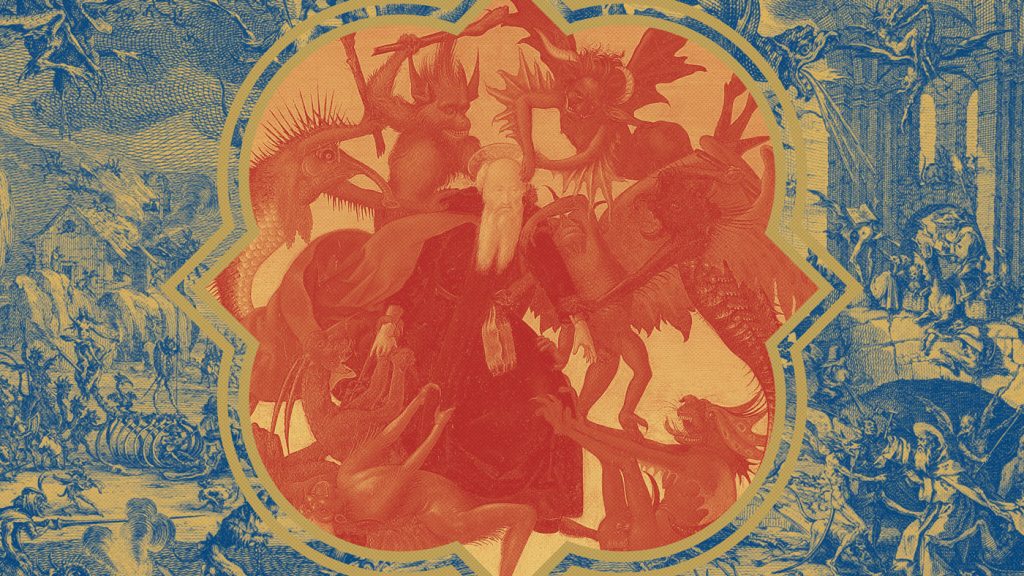
The Opposition is carried out by creatures we might call Demons. In the Gnostic literature, they’re referred to as Archons. These malevolent creatures, relegated by many to the realm of mythology, nonetheless, seem real as they destroy real lives.
A major task facing a spiritual warrior is sorting through false or misleading characterizations of the destructive agents to arrive at an accurate profile of demonic agents active in this world.
Mapping Intentions
Mapping the “terrain” of intentions, both divine and evil, is a must. With the aid of spiritual reflection, we assess the divine intentions that comprise the Will of God. In other words, we seek to discover or identify intentions that forward Divine Will.
Then we identify intentions that oppose each intention emanating from Divine Will. We identify intentions that fulfill the Will of God, and identify intentions that directly oppose the Will of God.
The resulting map of dichotomies—intention versus counter intention—pinpoints likely conflict hotspots. Each dichotomy signals a potential clash that has a “to be, or not to be” quality. This map identifies existential conflicts built into this universe. The resulting image might appear to be a matrix, a “soul trap” diagram.
Divine Collaboration Revisited
The “matrix” map represents conflicts that transcend or supersede conflicts resolved by reconciliation via Divine Collaboration.
In summary, when a conflict falls within standard parameters we turn to Divine Collaboration to facilitate an increase in affinity and good will based on reciprocity. With Direct Opposition to the Will of God, this is not possible.
In standard peacemaking, the conflict resolves as participants evaluate their positions (interests, needs, desires) with respect to the Will of God. Each party aligns their intentions with Divine Will; eventually, the disputants find their intentions align more and more with each other. Consensus leads to the greatest mutual benefit. This does not occur with anomalous conflicts in which Divine Will is opposed.
During Divine Collaboration we might be tempted to (wrongly) attribute existential evil to a disputant who seems to oppose the Will of God. In most cases, we discover a destructive hidden influence at work stoking fear that promotes a nihilistic mindset. Skilled mediators avoid false attributions of evil; instead, they help people identify hidden destructive influences, they help people jettison evil intentions, and they help people learn to align their intentions with Divine Will. This does not happen when a disputant is truly rooted in a desire to destroy Divine Will.
A New Discipline
Thus, when we encounter existential opposition, demonic agents directly opposing the Will of God, there can be no collaboration. Peacemaking must be set aside; we must transition to spiritual warfare. We must make the leap to a new discipline.
While spiritual warriors must possess the full range of Divine Collaboration skills, they must also acquire a new set of weapons. When the spiritual warrior confronts raw evil, the effort takes on heightened intensity requiring advanced skills.
Though exorcism and deliverance ministry disciplines exist, they do not seem sufficiently prepared for the task. Such skills are rarely taught within seminaries. As a result, we lack a well-developed spiritual warrior corps. This deficit of spiritual warriors can be confirmed by a cursory review of worldly conditions.
At this moment in history, we must ask, is spiritual warfare the new discipline we must develop to achieve world peace?
